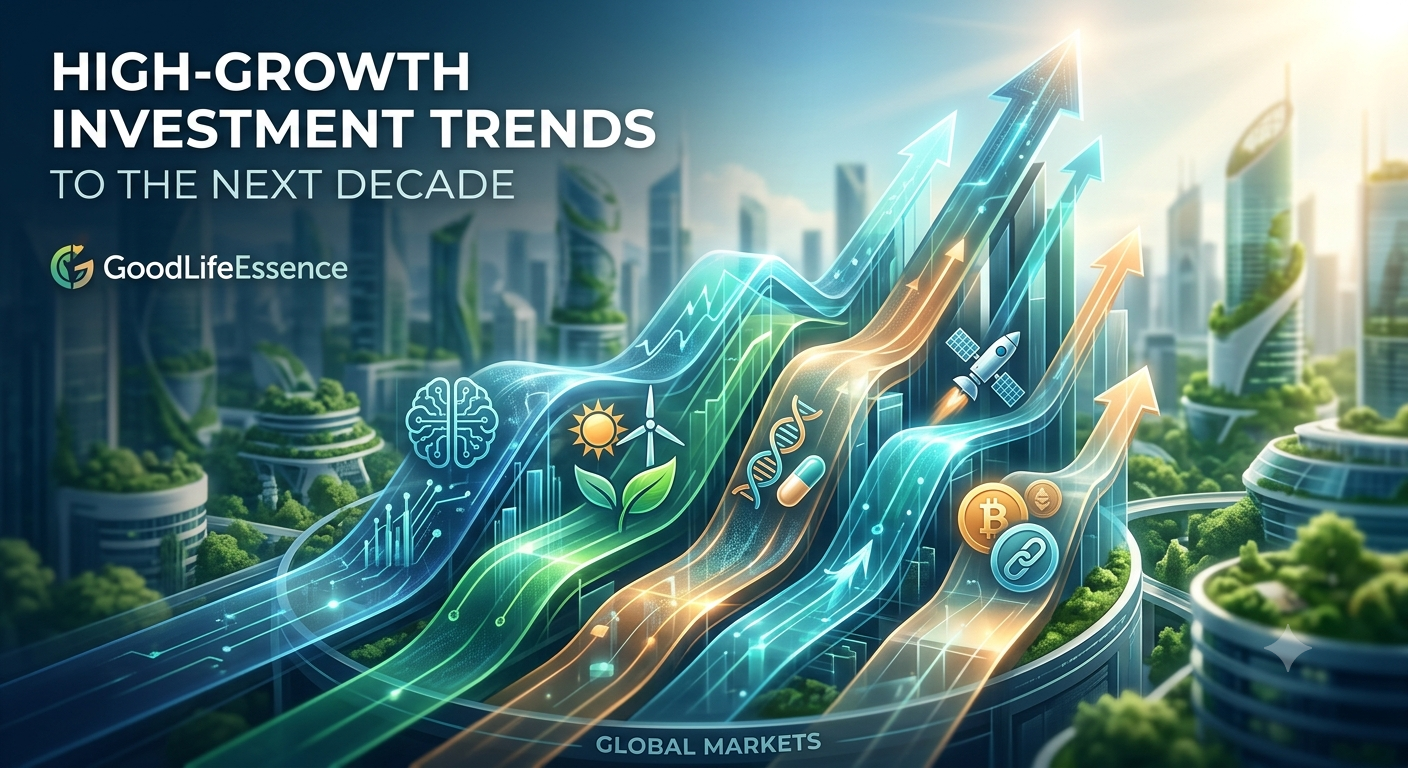
High-growth investment trends are the cornerstone of long-term wealth creation. As the global economy evolves at a blistering pace, traditional portfolios must adapt to capture exponential gains. Staying ahead of structural shifts isn’t just an advantage anymore—it’s a necessity.
Table of Contents
Whether you are a seasoned investor or just beginning to build your portfolio on goodlifeessence.com, aligning your capital with macro-level disruptions can completely transform your financial future. This comprehensive guide breaks down the 15 most powerful economic, technological, and societal shifts that will define the market over the next ten years.
The Macro Shift: Identifying Long-Term Value
Spotting a short-term hype cycle vs. a multi-decade mega-trend is what separates standard returns from life-changing wealth. The following trends represent structural transformations backed by massive capital inflows, government policy, and fundamental consumer behavioral changes.
1. Artificial Intelligence Infrastructure
The AI boom has moved past basic chatbots. The next decade belongs to the foundational layers of artificial intelligence. We are talking about massive data centers, high-performance silicon chips, liquid cooling systems, and specialized software architectures. As companies across every sector rush to integrate machine learning, the physical and digital infrastructure powering this revolution stands as one of the premier high-growth investment trends.
2. Next-Generation Energy Storage
Renewable energy generation is only half the battle. To truly replace fossil fuels, the world needs to solve the intermittency problem—meaning we need to store power for when the sun isn’t shining and the wind isn’t blowing. Investment is flooding into solid-state batteries, utility-scale grid storage, and alternative chemistries like sodium-ion. These innovations will transform automotive, aerospace, and consumer electronics markets.
3. Genomics and Precision Medicine
Healthcare is shifting from a “one-size-fits-all” treatment model to highly personalized therapy. Thanks to dropping costs in gene sequencing, CRISPR gene editing, and mRNA technologies, medical professionals can now target diseases at the cellular level. Companies pioneering these therapies, alongside the data platforms analyzing complex genetic code, represent high-growth investment trends with immense humanitarian and financial upside.
Industrial and Technological Transformations
4. Advanced Robotics and Automation
Faced with aging workforces and rising labor costs worldwide, industries are turning heavily toward automation. This trend goes far beyond traditional factory robotic arms. The next decade will see the commercialization of autonomous mobile robots (AMRs) in logistics, AI-driven sorting systems in retail, and even humanoid robots designed to work alongside humans.
5. Cybersecurity Frameworks
As our reliance on cloud architecture and connected devices increases, our vulnerability to malicious threats grows exponentially. Cybersecurity is no longer an optional IT expense; it is a core business continuity requirement. High-growth investment trends in this sector are leaning toward zero-trust architecture, AI-powered threat detection, and decentralized identity verification.
6. Decentralized Finance (DeFi) and Blockchain Assets
While traditional banking institutions remain slow and filled with friction, decentralized ledger technology is building a faster, parallel financial ecosystem. Beyond volatile crypto speculation, look toward tokenization of real-world assets (like real estate or commodities), automated smart contracts, and cross-border payment rails that operate instantly at a fraction of the cost.
7. Commercial Space and Satellite Networks
The space economy is officially open for business. Drastically lower launch costs have made satellite constellations highly profitable. Over the next ten years, businesses leading this space will dominate global broadband delivery, advanced earth imaging for climate and agriculture, and localized orbital manufacturing.
[Mega-Trend Capital Allocation Outlook]
+------------------------------------+------------------------+
| Sector                             | Projected 10-Yr CAGR   |
+------------------------------------+------------------------+
| AI Infrastructure & Semiconductors | 25% - 30%              |
| Next-Gen Energy Storage & Grid     | 18% - 22%              |
| Genomics & Precision Medicine      | 15% - 19%              |
| Advanced Robotics & Automation     | 12% - 15%              |
+------------------------------------+------------------------+
Sustainability and Supply Chain Resiliency
8. Smart Grid Infrastructure
Our current electrical grids were designed for a different century. To handle the massive influx of electric vehicles (EVs) and localized renewable energy sources, nations are aggressively upgrading to smart grids. These modern grids use IoT sensors, edge computing, and real-time data analytics to dynamically balance energy loads, prevent blackouts, and integrate green energy smoothly.
9. Water Security and Desalination Technology
Freshwater scarcity is becoming a defining geopolitical and economic issue. High-growth investment trends are emerging around advanced water filtration, closed-loop industrial recycling, and ultra-efficient desalination plants. Businesses that can clean, conserve, or transport water efficiently will secure steady demand regardless of broader economic downturns.
10. AgTech and Sustainable Agriculture
Feeding a growing global population under shifting climate conditions requires a radical overhaul of food production. Agricultural technology (AgTech) is meeting this challenge through vertical farming, precision drone spraying, automated harvesting machinery, and biological pest controls. These solutions drastically reduce water and chemical usage while driving crop yields higher.
11. Circular Economy and Materials Science
The linear “take-make-waste” industrial model is breaking down. Driven by consumer preferences and stricter regulations, companies are shifting toward circular manufacturing. This creates a massive market for advanced recycling technologies, biodegradable packaging alternatives, and green chemistry that replaces petroleum-based synthetics.
Evolving Consumer and Demographic Trends
12. Longevity and Silver Tsunami Care
The global population is aging at an unprecedented rate. Serving the “silver economy” opens massive opportunities. This encompasses more than just retirement communities; it spans longevity therapeutics, home care robotics, remote patient monitoring platforms, and wealth management services specifically designed for asset decumulation.
13. Digital Entertainment and the Creator Economy
The way media is produced and consumed has fundamentally flipped. Independent creators, interactive gaming platforms, and virtual reality ecosystems are capturing the attention shares once held by traditional television and film studios. Software platforms that enable monetization, distribution, and digital asset ownership are capturing the lion’s share of this monetization shift.
14. EdTech and Continuous Reskilling
Because high-growth investment trends are shifting the job market so rapidly, workers must continually learn new skills throughout their careers. Online educational platforms, VR vocational training simulators, and corporate upskilling programs are filling the gaps left by traditional universities, turning lifelong learning into a massive market.
15. Nearshoring and Autonomous Supply Chains
Recent global disruptions have exposed major structural cracks in over-extended supply chains. The next decade will favor regional resilience. Companies are heavily investing in nearshoring (bringing manufacturing closer to the home country) and building fully autonomous supply chains utilizing AI routing, automated ports, and predictive inventory tracking.
Portfolio Strategy: Navigating High-Growth Investment Trends
Investing in secular growth trends requires a distinct psychological approach compared to standard value investing. Volatility is an inherent part of the package when backing disruptive technologies or shifting consumer behaviors.
To win over the next decade, consider a core-satellite strategy. Keep the majority of your capital in stable, broad-market index funds, while allocating a specific “satellite” portion to targeted ETFs or individual equities positioned directly inside these high-growth areas. Rebalance annually to lock in gains from explosive sectors and prevent any single trend from over-exposing your net worth.
Summary
The next decade belongs to innovators solving the world’s most complex challenges. By anchoring your portfolio to these 15 high-growth investment trends—ranging from core AI infrastructure and next-gen energy storage to precision medicine and supply chain automation—you position your capital directly in front of the major economic tailwinds of our era. The keys to success remain patience, thorough diversification, and consistent focus on structural changes over short-term market noise.
Frequently Asked Questions
What makes an industry part of high-growth investment trends?
An industry joins these ranks when it is supported by structural changes rather than temporary fashion or cultural hypes. True growth trends are driven by major technological breakthroughs, shifting laws, or deep changes in global demographics that create lasting multi-year demand.
How much of my portfolio should I put into these aggressive sectors?
For most investors, a healthy allocation sits between 10% and 25% of their total portfolio. Keeping the rest in diversified core assets ensures your financial base stays secure while still giving you meaningful exposure to massive upside potential.
How do I protect my capital against volatility in these markets?
The absolute best defense is diversification and dollar-cost averaging. Instead of trying to guess the exact single winner of a new industry, invest across the entire sector using specialized ETFs, and buy into your positions gradually over time to smooth out price swings.
Where can I find more resources on wealth building and lifestyle design?
You can find deep dives into mindful wealth building, modern financial trends, and balanced living directly on goodlifeessence.com.