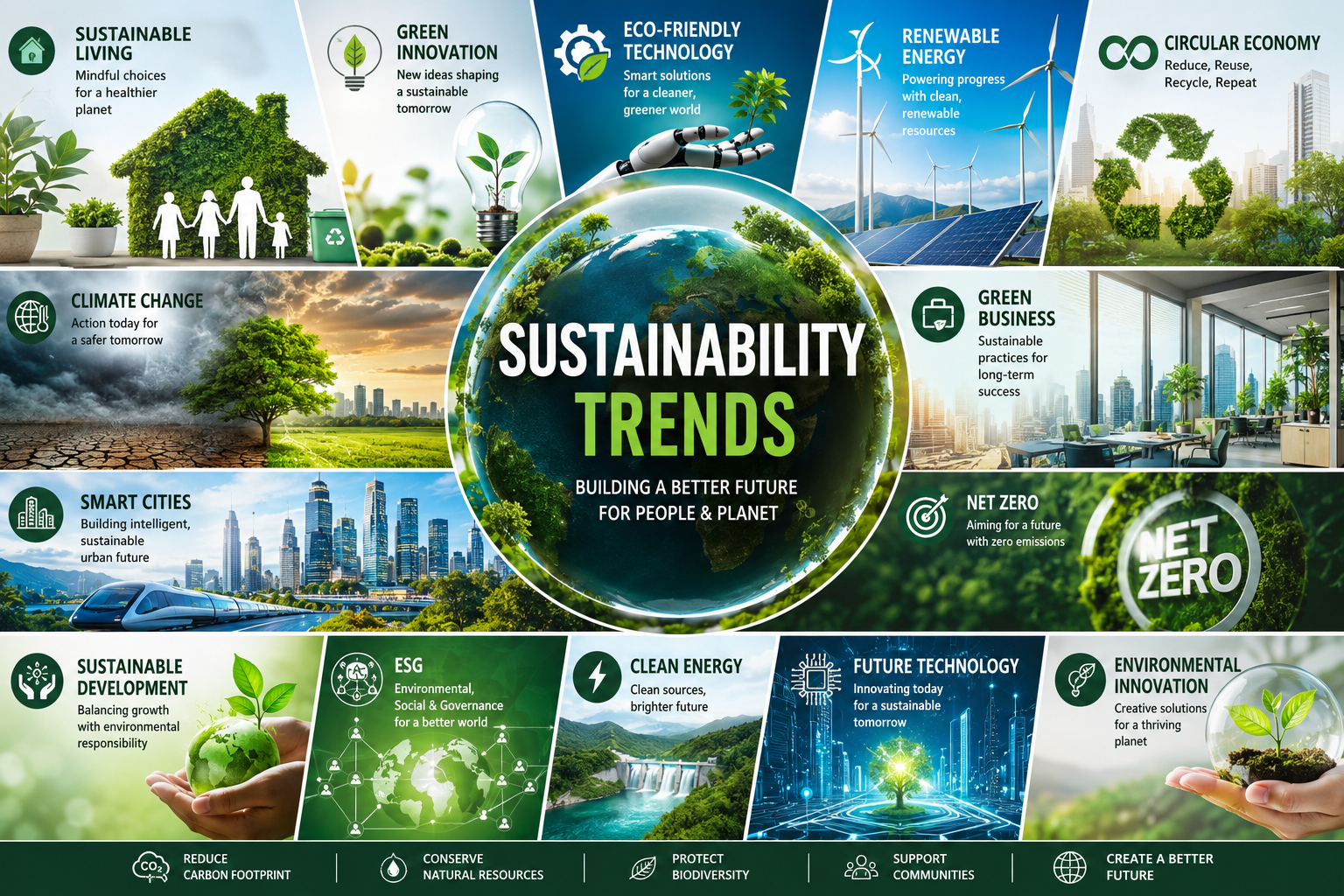
Sustainability Trends are reshaping industries, communities, and everyday lifestyles faster than ever before. As the world enters 2026, governments, businesses, and individuals are embracing innovative technologies and environmentally responsible practices to reduce carbon emissions, conserve natural resources, and build a resilient future.
The latest Sustainability Trends are driven by artificial intelligence, renewable energy, circular economies, smart cities, green construction, and climate-focused innovations. These advancements are helping organizations reduce waste, improve efficiency, and create long-term economic value while protecting the planet.
In this comprehensive guide, we’ll explore 10 game-changing Sustainability Trends transforming 2026 and why these innovations matter for businesses, homeowners, investors, and future generations.
Table of Contents
Why Sustainability Trends Matter in 2026
Modern Sustainability Trends are no longer optional. Consumers increasingly support environmentally responsible brands, governments are introducing stricter climate regulations, and investors prioritize sustainable companies with strong ESG performance.
The benefits include:
- Reduced environmental impact
- Lower operating costs
- Increased energy efficiency
- Better brand reputation
- Stronger long-term profitability
- Improved public health
- Greater climate resilience
Organizations adopting these Sustainability Trends today will remain competitive for years to come.
1. Sustainability Trends in Renewable Energy Expansion
Renewable energy continues to dominate global sustainability efforts.
Major innovations include:
- Advanced solar panels
- Floating solar farms
- Offshore wind energy
- Green hydrogen production
- Improved battery storage
Countries are investing heavily in renewable infrastructure to reduce fossil fuel dependence and achieve net-zero emissions.
This Sustainability Trends movement is creating millions of green jobs while lowering electricity costs.
2. Sustainability Trends in Artificial Intelligence
Artificial Intelligence is becoming one of the biggest sustainability enablers.
AI helps organizations:
- Predict energy consumption
- Optimize transportation
- Reduce food waste
- Monitor forests
- Improve recycling
- Detect water leaks
Smart algorithms significantly reduce resource consumption while increasing operational efficiency.
These AI-powered Sustainability Trends represent one of the most exciting developments of 2026.
3. Sustainability Trends in Circular Economy
The traditional “take, make, dispose” model is being replaced by circular systems.
Businesses now focus on:
- Recycling materials
- Repairing products
- Product-as-a-service models
- Waste reduction
- Resource recovery
The circular economy minimizes environmental damage while maximizing product lifespan.
Among all Sustainability Trends, circular manufacturing has become essential for modern businesses.
4. Sustainability Trends in Green Buildings
Buildings account for significant global carbon emissions.
New sustainable construction includes:
- Net-zero homes
- Energy-efficient insulation
- Smart lighting
- Rainwater harvesting
- Solar roofing
- Green roofs
- Low-carbon concrete
Modern green buildings reduce utility bills while improving indoor air quality.
These construction-focused Sustainability Trends continue transforming cities worldwide.
5. Sustainability Trends in Electric Transportation
Transportation is undergoing a revolutionary transformation.
Key innovations include:
- Electric cars
- Electric buses
- Electric trucks
- Charging infrastructure
- Battery recycling
- Hydrogen-powered vehicles
Governments worldwide are encouraging clean transportation through incentives and infrastructure investments.
Electric mobility remains one of the fastest-growing Sustainability Trends.
6. Sustainability Trends in Sustainable Agriculture
Agriculture is becoming smarter and greener.
Important developments include:
- Precision farming
- AI-powered irrigation
- Vertical farming
- Hydroponics
- Organic farming
- Drone monitoring
- Regenerative agriculture
Farmers can now produce more food while using less water and fertilizer.
These agricultural Sustainability Trends improve food security while protecting ecosystems.
7. Sustainability Trends in Water Conservation
Freshwater scarcity remains one of humanity’s greatest challenges.
Innovations include:
- Smart water meters
- Wastewater recycling
- Desalination improvements
- Rainwater harvesting
- Leak detection systems
Water-efficient technologies reduce waste while ensuring reliable supplies for growing populations.
Water management has become a major focus within global Sustainability Trends.
8. Sustainability Trends in Carbon Capture
Many industries cannot immediately eliminate emissions.
Carbon capture technologies help by:
- Removing carbon dioxide
- Storing emissions underground
- Producing carbon-neutral fuels
- Supporting industrial decarbonization
These solutions complement renewable energy and accelerate climate goals.
Carbon removal is becoming one of the most discussed Sustainability Trends of 2026.
9. Sustainability Trends in Smart Cities
Cities are becoming increasingly intelligent.
Features include:
- Smart traffic systems
- Energy-efficient streetlights
- Intelligent waste management
- Public EV charging
- Smart grids
- Green public transportation
Smart cities reduce pollution while improving quality of life.
Urban innovation remains central to future Sustainability Trends.
10. Sustainability Trends in Sustainable Consumer Products
Consumers increasingly demand eco-friendly products.
Popular innovations include:
- Compostable packaging
- Refillable containers
- Biodegradable materials
- Plastic alternatives
- Eco-friendly fashion
- Sustainable furniture
Brands embracing these Sustainability Trends build stronger customer trust while reducing environmental impact.
How Businesses Can Adopt Sustainability Trends
Organizations can begin implementing Sustainability Trends through practical steps:
- Conduct sustainability audits.
- Invest in renewable energy.
- Reduce packaging waste.
- Improve energy efficiency.
- Implement recycling programs.
- Train employees on sustainability.
- Measure carbon emissions.
- Source sustainable materials.
- Publish ESG reports.
- Set measurable sustainability goals.
Small improvements today create significant environmental and financial benefits tomorrow.
Future of Sustainability Trends Beyond 2026
The future of Sustainability Trends looks incredibly promising. Emerging technologies such as AI-driven climate modeling, carbon-negative manufacturing, next-generation battery storage, advanced recycling systems, and renewable hydrogen will continue transforming industries worldwide.
Businesses that invest early in Sustainability Trends will enjoy increased resilience, stronger customer loyalty, regulatory compliance, and long-term profitability. Sustainability is no longer just an environmental responsibility—it has become a competitive business strategy that drives innovation and growth.
Conclusion
Sustainability Trends are transforming the way people live, work, manufacture products, and protect the environment. From renewable energy and artificial intelligence to circular economies and smart cities, these innovations are building a cleaner, healthier, and more prosperous future.
Whether you are a homeowner, entrepreneur, investor, policymaker, or student, embracing Sustainability Trends today will help create lasting value for future generations. By adopting sustainable practices and supporting innovative technologies, everyone can contribute to a greener and more resilient world.
Summary
| Innovation | Key Benefit |
|---|---|
| Renewable Energy | Clean electricity generation |
| Artificial Intelligence | Resource optimization |
| Circular Economy | Waste reduction |
| Green Buildings | Energy efficiency |
| Electric Transportation | Lower emissions |
| Sustainable Agriculture | Efficient food production |
| Water Conservation | Freshwater protection |
| Carbon Capture | Emission reduction |
| Smart Cities | Sustainable urban living |
| Sustainable Products | Eco-friendly consumption |
Frequently Asked Questions (FAQ)
1. What are Sustainability Trends?
Sustainability Trends are emerging innovations, technologies, and practices that promote environmental protection, resource efficiency, and long-term economic growth.
2. Why are Sustainability Trends important in 2026?
They help reduce carbon emissions, improve energy efficiency, conserve natural resources, and support sustainable economic development.
3. Which industries benefit the most from Sustainability Trends?
Energy, construction, transportation, agriculture, manufacturing, technology, retail, and finance all benefit significantly.
4. How does AI support Sustainability Trends?
AI optimizes energy use, predicts maintenance, reduces waste, improves farming, and enhances environmental monitoring.
5. What is a circular economy?
A circular economy focuses on reusing, repairing, recycling, and extending product lifecycles to minimize waste.
6. How do green buildings support Sustainability Trends?
Green buildings reduce energy consumption, lower emissions, improve indoor air quality, and decrease operating costs.
7. What role do electric vehicles play?
Electric vehicles reduce greenhouse gas emissions, improve air quality, and decrease dependence on fossil fuels.
8. What are smart cities?
Smart cities use digital technology, AI, IoT, and renewable energy to improve transportation, utilities, and environmental sustainability.
9. Can small businesses adopt Sustainability Trends?
Yes. Small businesses can reduce waste, improve energy efficiency, source sustainable materials, and implement recycling initiatives.
10. What is the future of Sustainability Trends?
Future Sustainability Trends will include carbon-negative technologies, advanced renewable energy systems, AI-driven sustainability solutions, smart infrastructure, and innovative circular economy models.